
Remember when it was just you and your chair? Life was simpler. You knew exactly how much product you used, what you earned, and when your next client was coming in. Then you hired your first stylist. Maybe a second. And somewhere between celebrating your growth and wondering where all your profit went, things got... messy.
You're not imagining it. According to the NHBF's quarterly State of the Industry survey, 73% of salon owners say it's harder to find and retain staff compared to a year ago, with only 16% planning to hire new team members. When staff management goes wrong, everything else falls apart. Turns out, the skills that make you an amazing stylist don't automatically translate into knowing how to manage a salon team. Who knew, right?
Here's the thing, though: you don't need an MBA or a fancy operations manager to fix this. You just need solid salon management tips, the right systems, and a bit of honest reflection about what's actually going wrong.

Before we jump into tips for managing your salon staff, let's acknowledge what you're probably dealing with. Because until you see the problem clearly, you can't fix it.
When you were solo, tracking revenue was easy, as every dollar was yours. Now you've got three stylists sharing a color bar, and somehow you're spending way more on supplies but can't figure out why. Is Maya being heavy-handed with the color? Is everyone just busier? Or is the product literally walking out the door?
Meanwhile, you know Jen is a retail queen but books fewer services. And Carlos is always packed but never sells a single product. Are they both equally valuable to your business? You genuinely don't know, and that uncertainty makes everything from commission conversations to scheduling decisions feel like guesswork. Effective salon staff management requires visibility into these numbers.
Last Tuesday, you had three clients show up for the same time slot. How? Because someone wrote in the paper book, someone else texted you, and the third booked through Instagram DMs. Your phone is blowing up with "Am I working Saturday?" texts. You spent your Sunday evening, your ONE day off, trying to piece together next week's schedule.
Sound familiar? This is exactly why learning how to manage a salon properly matters so much.
You want to be transparent with your team. But should your newest hire really see what everyone else is making? Does your receptionist need access to delete client records? When everyone can see everything, things get weird. When no one can see anything, they can't do their jobs. There's got to be a middle ground, but figuring it out feels like one more thing on your endless to-do list.
A client complains about a botched appointment. Three people touched that booking. Who messed up? With no clear trail of who did what, accountability becomes impossible. Small issues fester because addressing them feels unfair when you can't prove anything.
Here's a framework that delivers real results. Not because it's revolutionary, but because it's practical. These are tips for managing your salon staff that you can start implementing tomorrow morning.

This sounds basic, but it's one of the most important salon management tips you'll ever get. Right now, there's probably a bunch of unspoken assumptions floating around your salon. Does your senior stylist have the authority to give discounts? Can your receptionist modify someone else's schedule? Who's supposed to order supplies when you run low?
Grab a notebook (yes, actual paper) and write down every single task that happens in your salon. Booking appointments. Processing payments. Ordering inventory. Accessing financial reports. Changing service prices. Managing client info. All of it.
Now assign each task to a specific role. Not a person but a role. Because people come and go, but roles stay. This clarity is foundational to strong salon staff management.
Here's roughly how it might break down:
Write this down. Share it with your team. Suddenly, everyone knows their lane. That's how to manage a salon where people actually thrive.
I know, I know. The paper book has worked for years. But it doesn't scale. It just doesn't.
You need a system where:
This is where tools like Goldie's team management feature become game-changers. You add your team members, set their individual access levels based on those roles you just defined, and boom, like magic, everyone's calendar is synced. Clients book online through your link. Staff get automatic notifications. You stop playing telephone.
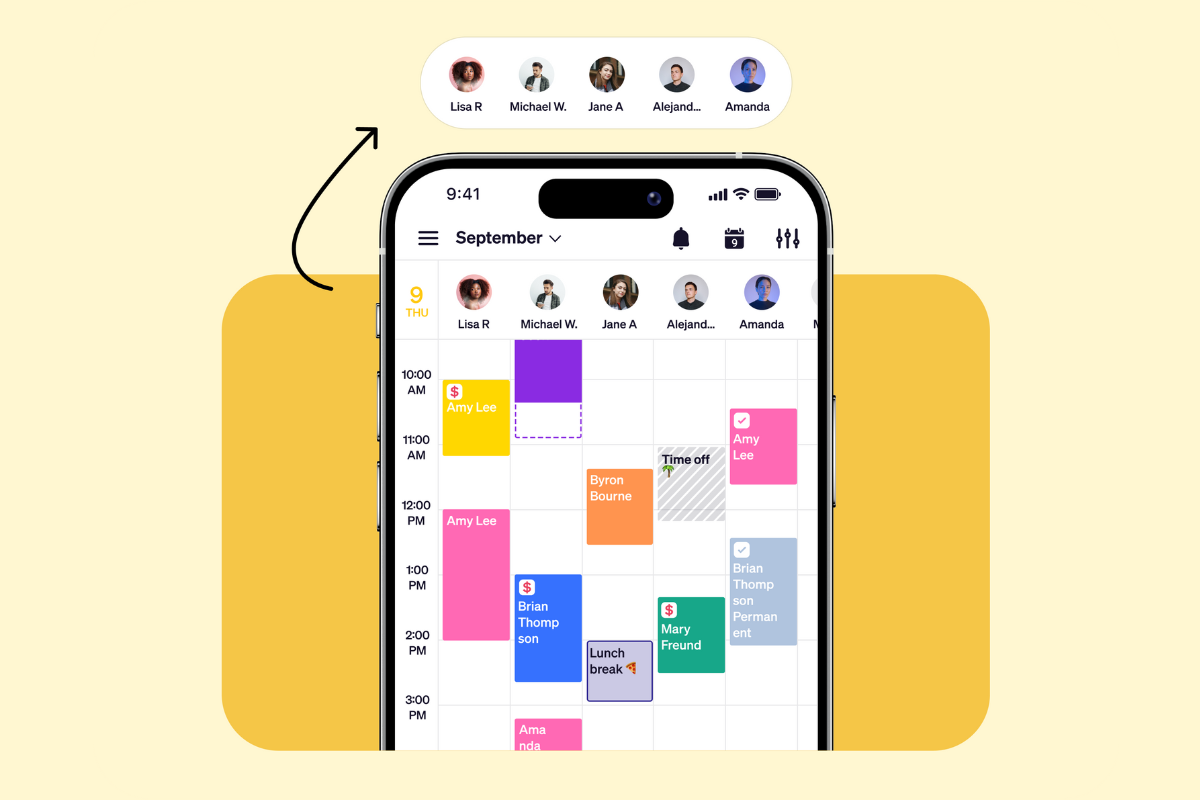
The best part? When clients can book online and you can take deposits up front, no-shows drop dramatically. Your prime Saturday slots don't sit empty because you were too busy foiling to answer the phone.
Solid salon staff management means giving your team the tools they need while keeping you in control.
Here's where it might feel uncomfortable, but push through. You need to know, for each person:
This isn't about creating a toxic competition or making anyone feel bad. It's about having real conversations based on real data. This is one of those salon management tips that separates struggling salons from thriving ones.
Imagine sitting down with a stylist who's struggling. Instead of vague "you need to do better," you can say "Hey, I noticed your retail sales are lower than your service performance. Let's talk about what's going on. Are you uncomfortable recommending products? Do you need more training on what we carry? How can I support you?"
That's a productive conversation. That's coaching, not criticizing. That's how to train the employees of your salon to actually improve.

Modern salon apps generate these reports automatically. With Goldie, for instance, you can see your total earnings broken down by staff member in a few taps. No more spreadsheets, no more guessing.

Nobody loves meetings. But a quick weekly check-in prevents so many problems. If you're serious about learning how to manage a salon effectively, communication can't be optional.
Here's a format that works: 15-20 minutes every Monday morning. Cover four things:
That's it. You're not solving world hunger. You're staying aligned.
Once a month, go deeper. Share performance numbers. Yes, share them. When your team understands how their work impacts the bottom line, they start thinking like owners, not employees. Transparency builds trust. This is one of the most underrated tips for managing your salon staff.
But here's the key: document what you discuss and what you decide. "We talked about retail" means nothing. "Carlos is going to assist Jen during three retail conversations this week" means something.
Remember those roles you defined? Now enforce them digitally. Smart salon staff management means matching access to responsibility.
Your salon software should let you control exactly who sees what. Can stylists view client contact details? Maybe yes for their own clients, no for everyone else's. Can your receptionist delete appointments? Probably only cancel, not fully delete. Can your manager see individual performance reports? Yes. Can they change service prices? Probably not without checking with you first.
Goldie's roles and permissions system is built exactly for this, and it's super flexible about how much or how little access each team member has. You're not forcing people into rigid boxes. You're matching access to responsibility and trust level.
This protects your business, and honestly, it protects your team too. When there's a clear trail of who did what, misunderstandings get cleared up quickly instead of festering. That's how to manage a salon that runs smoothly even when you're not watching every move.

Set up a simple system where product usage gets logged. When someone uses color, they note it. When retail sells, it's attributed to whoever recommended it.
Yes, this is extra work upfront. But after a month, you'll have data that tells stories. Maybe you'll discover one stylist consistently uses more product for the same service, and that's a training opportunity, not a criticism. Maybe another stylist is incredible at retail but books fewer services, and perhaps their role should shift slightly.
Knowing how to train the employees of your salon includes helping them understand the cost behind every service. When they see how product waste impacts margins, they become more conscientious.
Do weekly inventory counts. I know, tedious. But when you catch discrepancies early, you stop bleeding money you didn't know you were losing.
Let me share a real example. Chelle Neff founded Urban Betty in Austin, Texas, in 2005 with just six chairs and one contractor. She ran everything herself: reception, accounting, styling clients, and marketing. Sound familiar?
For twelve years, Chelle was still doing hair while managing a growing team. "I was burned out, exhausted, and ready to quit," she later shared. She needed salon management tips badly, but she was too busy putting out fires. It was too much for one person.
The turning point? She brought on a business coach and finally learned how to manage a salon as a business. She defined clear roles, brought on two employees as shareholders, and created a leadership structure where everyone knew their responsibilities. She invested in scheduling software to automate reminders and fill cancellations. She established transparent performance tracking. She figured out how to train the employees of your salon through regular education and clear advancement paths. That's solid salon staff management in action.
The results? Urban Betty grew from six chairs to over 60 employees across multiple locations. They've been named one of the Top 200 Salons in the U.S. by Salon Today Magazine eleven times. A quarter of their stylists now earn six figures.
"After taking the leap, the salon company has only grown and become more profitable," Chelle reflected. Her story proves that learning how to manage a salon effectively isn't optional if you want to grow. It's the whole game.
Look, managing a team isn't easy. Nobody gave you a manual when you decided to grow your business. But you don't have to figure it all out alone, and you don't need to keep white-knuckling through the chaos.
Start somewhere. Pick one of these tips for managing your salon staff and do it this week. Maybe it's finally writing down those role definitions. Maybe it's trying out scheduling software. Maybe it's just having that first real team meeting.
Your team wants to succeed. They want to know what's expected of them. They want to be recognized when they do well. Give them the structure to thrive, and they'll surprise you.
Learning how to manage a salon is a journey, not a destination. You'll keep refining your approach as your team grows. And give yourself a break, too. You're building something. It's allowed to be messy while you figure it out. The fact that you're reading this means you care about doing it right. That counts for a lot.
Now go take control of this thing. You've got this.
Want to see how proper salon staff management software can actually work for your salon? Check out Goldie's staff management features and see why customizable roles and permissions matter.

.webp)