Your next $6,000 probably isn't hiding in a new client's DMs. It's sitting in your client list, with people who loved their last appointment, meant to rebook, and just didn't.
If you want to increase salon revenue this year, rebooking is the lever most beauty pros underestimate. Not because it's complicated, but because the loss is invisible. Nobody cancels. Nobody complains. A client who used to come every six weeks starts coming every ten, and you never see the money that went missing.
So let's put real numbers on it: manual rebooking versus automated rebooking, and what the gap looks like after 12 months.

Because you already paid to get them. Acquiring a new customer is anywhere from five to 25 times more expensive than keeping an existing one, according to research on customer retention in Harvard Business Review.
Think about what a new client really costs you: Instagram ads, a first-visit discount, a longer consultation and the chance they never come back. Getting a regular back in your chair, on the other hand, can take one well-timed text.
That's why the smartest salon retention strategies start with the people already in your chair, not the ones scrolling past your posts.
Even the Bureau of Labor Statistics' profile of hairstylists and cosmetologists points out that clients who receive timely hair care are more likely to return. So timing isn't just calendar admin. It's part of how you keep people.
In this example, moving from 40% to 70% on-time rebooking is worth roughly $6,100 a year for a hairstylist with 80 active clients.
Here's the example we're working with:
These are example numbers, and so are the two rebooking rates below. They're a hypothetical to show what the gap is worth, not a Goldie benchmark, so plug in your own.
With manual rebooking, you're relying on memory. Yours and theirs. You're running 15 minutes behind, so you forget to ask at checkout. Or the client says "I'll book once I check my calendar," and disappears for two months. In this scenario, 40% rebook on time.
Now picture the same client list with automated reminders, where every client gets a nudge at the right moment whether you remembered or not. Say 70% rebook on time.
That's 72 extra appointments, about one and a half a week, from people who already know and trust your work.
Nail techs feel this even harder, because fill cycles are shorter. Say you have 60 clients paying $55 for a gel fill every three weeks, about 17 visits a year. Clients who miss the window stretch to every five weeks, closer to 10 visits.
If some drifting clients eventually stop coming, the gap grows every quarter, because your client base shrinks along with it.
The first example only counts fewer visits. It doesn't assume anyone leaves for good. But a client who stretches to 10 weeks has more time to try someone new. Maybe the stylist closer to their office. Maybe a box dye "just this once."
So let's run a second hypothetical: 1 in 10 drifting clients doesn't come back the following quarter. That's not an industry benchmark, just an assumption to show how the math stacks up. Same hairstylist, same $85 ticket.
By month 12, the gap is about $7,600 instead of $6,100. And under this assumption, the stylist using automated reminders walks into January with roughly 71 active clients instead of 63.
Now think about replacing those eight clients. If a new client can cost five to 25 times more to win than an existing one costs to keep, rebuilding that client base gets expensive fast. That's why real salon revenue growth rarely comes from marketing alone. It comes from not leaking what you already have.
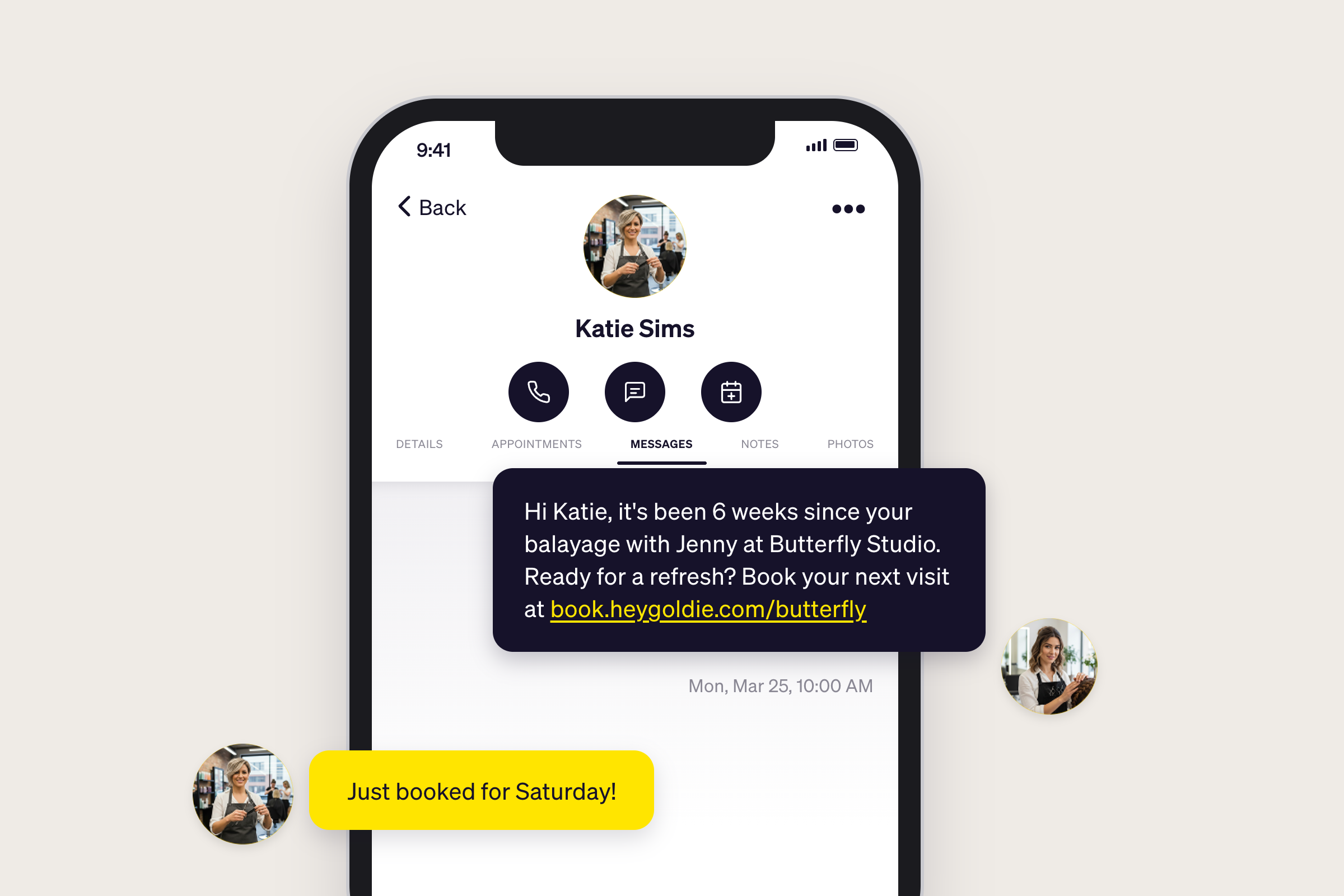
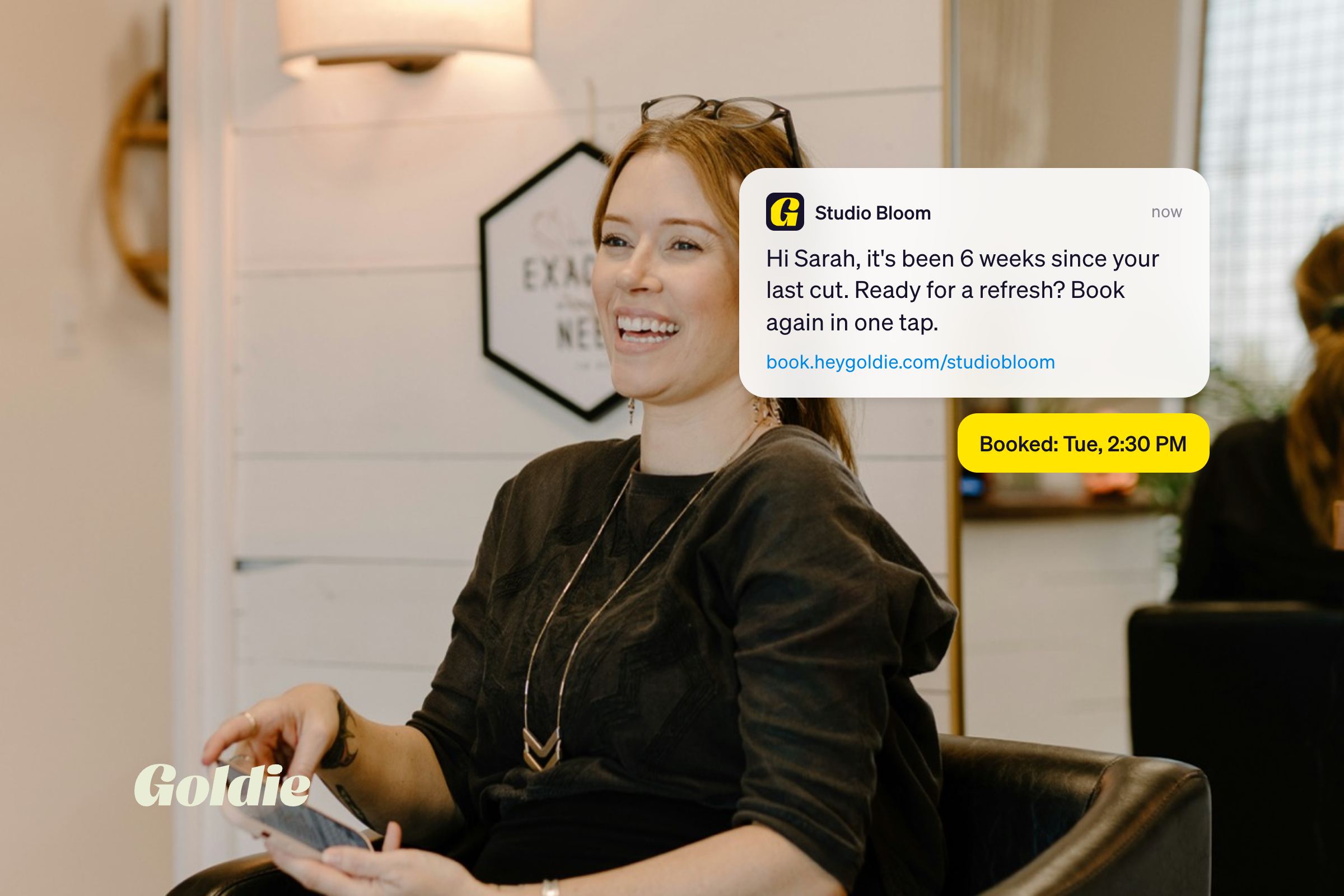
Goldie sends a rebooking reminder after an appointment, but only if the client hasn't already booked their next visit.
The default reminder goes out 30 days after an appointment, and you can adjust that timing to match how often your clients usually come back. The smart part is the condition: clients who already rebooked at checkout don't get a pointless text, and the ones who slipped through get a friendly nudge with your booking link.
To get the most revenue out of it:
Clients opt in to texts first by replying YES. From there, it's mostly about wording: short, warm messages that sound like you are what make rebooking reminders boost client retention.
Your rebooking rate is a revenue number. If you have open spots on your calendar, getting clients back on time keeps that revenue from being delayed or lost for good.
Most pros think of reminders as a convenience. That undersells them. A rebooking reminder is marketing that goes only to people who already said yes to you. Of all the salon retention strategies out there, it's also the easiest to measure. It's the part of client retention beauty pros can actually put a number on.
So track it like revenue. Learn how to calculate your salon client retention rate and check it every month. If the number is lower than you'd like, automated rebooking is an easy place to start, because it works on every client, not just the ones you remember to ask.
Then layer it with other habits from our list of salon retention strategies, like client notes, birthday messages, and loyalty perks. Reminders get clients back in the chair. The experience is what keeps them there.
Start with the clients you already have. Raising your on-time rebooking rate adds appointments without adding marketing costs, which makes it one of the most profitable ways to increase salon revenue. After that, look at retail and expenses, since there are plenty of ways to increase salon profit without raising prices.
At an $85 average ticket, $100,000 in service revenue means about 1,176 appointments a year, or roughly 23 a week. Keep in mind that's revenue before rent, products and taxes, not take-home pay. With 70% of clients rebooking on time, each client visits about 7 times a year, so you'd need around 166 active clients. At 40%, you'd need closer to 190. That's why the road to six figures runs through the kind of client retention beauty pros can plan a year around.
It gets more visits out of the clients you already have. When people come back closer to their ideal service cycle, the same client list fills more of your calendar. In the hairstylist example above, going from 40% to 70% on-time rebooking adds 72 appointments a year without a single new client. That's salon revenue growth you don't have to buy with ads.
In our hairstylist example, a 30-point jump in on-time rebooking is worth about $6,100 a year. And if some drifting clients lapse along the way, the gap gets even bigger. None of it requires a single new ad.
That's the kind of client retention beauty businesses are built on. Turn on Goldie's automated reminders, set the timing to match your services and let every client get a nudge right when they need it.
With automated rebooking doing the remembering for you, your fullest calendar yet could be sitting in the client list you already have!

.webp)