
If you're running a salon or working as an independent stylist, knowing how much does a haircut cost in the US helps you price competitively without walking a tightrope. Charge too much, and clients might look elsewhere. Charge too little, and you're leaving money on the table while undervaluing your expertise. Understanding average haircut prices across the United States gives you the context you need to price competitively while still making a profit.
The average haircut price US for a standard haircut ranges from $35 to $70, depending on service type and location, but that number tells only part of the story. Your location matters more than you might think. So does your experience level. And yes, unfortunately, whether you're cutting men's or women's hair still makes a big difference in what clients expect to pay. Let's look at what haircuts actually cost across different states so you can figure out the right pricing for your chair.

When determining how much does a haircut cost in the US, location is hands down the biggest factor. A basic men's cut in rural Mississippi might run $20 to $45, while that same service in Manhattan could easily hit $60 to $80. This isn't about one stylist being better than another. It's about the cost of living, local competition, and what the market in your area can support.
Rent costs drive a huge portion of this variation. Salons in New York City or San Francisco face monthly rent bills that would cover an entire year in smaller markets. Those overhead costs have to get built into service prices somehow.
Your target demographic matters too. Upscale neighborhoods with higher-income residents will support premium pricing that budget-conscious areas won't. A stylist working near tech campuses in Seattle operates in a completely different pricing environment than someone serving a college town in the Midwest.

When researching the average haircut price US, you’ll find that the nationwide average price for a haircut sits around $56, with men's cuts averaging $43 and women's services running about $69. However, the average women's haircut price by state varies even more dramatically than men's pricing due to service complexity.
Haircut pricing has jumped roughly 75% over the past two decades, driven by inflation and steadily climbing operating costs. Where things get interesting is how differently this plays out state by state. Local tax structures, what you're paying in rent, and your regional economy create pricing environments that look nothing alike. Running a salon in a no-income-tax state with affordable retail space? You're playing an entirely different game than someone leasing premium square footage in a high-tax market.
The table below breaks down average haircut prices across all 50 states, showing you where your market actually sits.

The average haircut price US for men's haircut pricing tells a story about your local market that goes way beyond just what you should charge. According to recent industry data, the national average for men's haircuts sits around $43. Where you're located makes a massive difference in what clients expect to pay and what your competition charges.
Here's why this matters: knowing the average men's haircut price by state helps you set rates that make sense for where you actually work, not some vague national number that doesn't mean much for your business.

Women's haircuts cost more, and it's not just about where your salon is located. These cuts take longer and involve way more steps. Across the country, you're looking at an average of about $69. CNN reported that women's cuts range from $45 to $75, which usually covers the consultation, shampoo, the actual cut, and styling. This explains why women's services generally cost $20 to $30 more than comparable men's haircuts.
Figure out where your state lands in all this, and you'll know exactly how to price women's cuts, so you're competitive but still making good money.
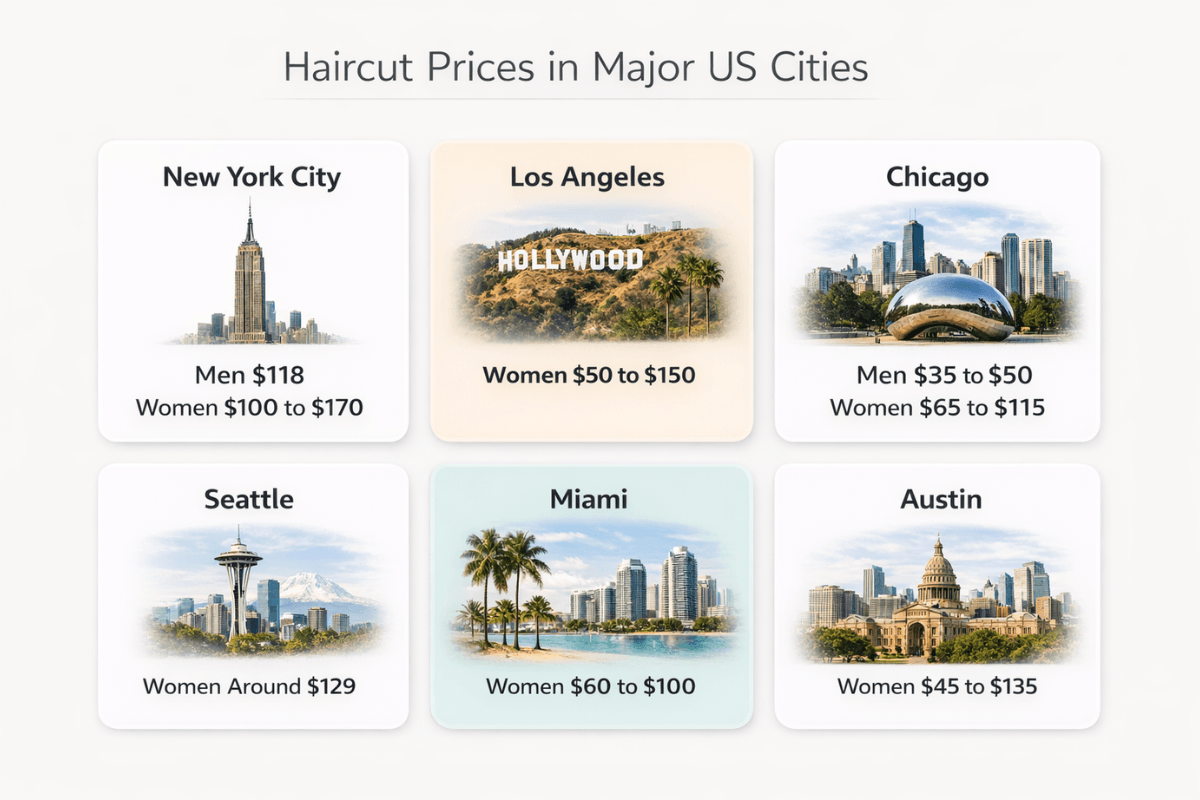
Haircut prices in major US cities reveal how dramatically costs shift even within the same state, going far beyond what state averages suggest. Big cities charge more. It's that simple. Commercial rent costs a fortune, salons compete for the best stylists, and clients have bigger budgets. That's just how it works in metropolitan areas compared to the suburbs or smaller towns.
When people ask how much does a haircut cost in the US, you can't just look at state averages. New York City leads the nation with men's cuts averaging $118 and women's services running $100 to $170. In Los Angeles, women's cuts go anywhere from $50 to $150, depending on which neighborhood you're in and how your salon positions itself. Chicago sits at $35 to $50 for men and $65 to $115 for women. Even in big Midwest cities, prices stay more reasonable.
Seattle's pushing women's cuts to around $129, which drives up Washington's whole state average. Miami's doing the same thing for Florida at $60 to $100. Boston runs $40 to $60 for men's cuts. And Austin? It's showing how Texas's booming economy affects pricing, with women's services hitting $45 to $135.
Here's why understanding haircut prices in major US cities matters, even if you're nowhere near them: big cities set the trends. What works in Seattle today will hit Spokane and Tacoma in 2 to 3 years. Chicago's pricing tells you what Milwaukee and Indianapolis will start charging soon. You're not just seeing what big cities charge right now. You're seeing where your own market is headed.

Start by checking out what other salons near you are charging for similar services. Here's the thing: you're really only competing with places within a 5 to 10 minute drive. That salon across town? Not your competition.
Be real about where you are in your career. Just got your license? Price yourself 10% to 20% below the established stylists around you. That's smart, not selling yourself short. As you build up your client list and get better at what you do over the next few years, bump up your rates bit by bit. Most successful stylists increase their prices regularly, usually around 10% per service.
Your overhead costs must factor into pricing decisions. Calculate what you're spending on rent, products, utilities, insurance, and other business expenses. If you're booth renting, make sure your pricing covers that monthly cost plus your income needs. Commission stylists need to account for their percentage split when setting prices that the salon will charge.
Track your numbers using reliable systems. Goldie lets you monitor exactly which services bring in the most revenue, how long different services actually take, and which price points keep your schedule full without leaving money on the table. Having real data about your business performance takes the guesswork out of pricing decisions.

The average haircut price US by state gives you the context you need, but your specific pricing should reflect your unique situation. A newly licensed stylist in rural Kentucky should price very differently from a ten-year veteran in downtown Chicago, even though both provide valuable professional services to their communities.
Pay attention to what's happening in your immediate market. When competing salons raise haircut prices in major US cities, that often signals the local market can support higher rates. What you charge tells clients what they're getting. Don't underprice yourself, but don't ignore what actually works in your area either. Price based on your skills and what your local market can handle.
Want to stop guessing at your pricing? Start tracking your services, costs, and client retention with Goldie so you can make smart decisions based on real numbers. When you actually know what's working and what's not, pricing stops feeling stressful and starts making sense.

.webp)